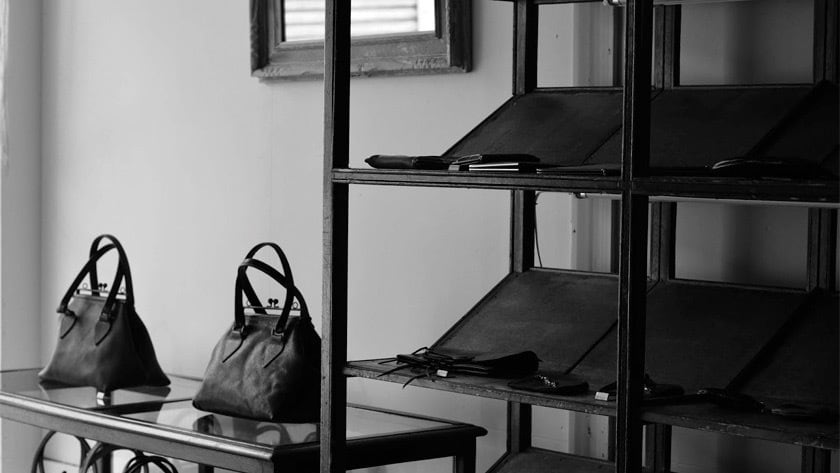
と革と革の関係
食として命をいただく。
その副産物として、革を受け取る。
かつては当たり前だったことが、
今はそうではなくなっている。
エコシステムが崩れ、山と人の距離が開いた。
害獣と呼ばれ、ただ山の中で終わっていく命がある。
その時間を、もう一度手の中で紡ぎ直すこと。
それが、野生皮革ージビエ革ーと向き合う理由だと思っている。
浅草は、革の街。
合羽橋は、料理人の街。
命をいただく場所と、
その痕跡を扱う場所が、隣り合っている。
だからここにある。
と革は、その境目に立っている。
We receive life as food.
And leather, as its byproduct.
What was once a matter of course
is no longer so.
The ecosystem has fractured. The distance between mountain and people has grown.
There are lives that end in the mountains, labeled as pests, simply discarded trace.
To take that time and spin it back into our hands.
That is why we work with wild leather — gibier™️ leather.
Asakusa is the leather district.
Kappabashi is the chef’s district.
The place where life is received as food,
and the place where its traces are worked,
stand side by side.
That is why we are here.
To-Kawa stands at that boundary.
Six COUP DE FOUDRE
Six coup de foudre
フランス語で、第六感で一目惚れ。
言葉の奥には、
「死す」「喰う」「food」の音が重なっている。
生きるために頂く生命と、
その副産物として残る革。
その二つを分けずに扱うこと。
理屈ではなく、
感覚で惹かれるものをつくる。
Six coup de foudre.
In French, love at first sight, through the sixth sense.
Within the words, other sounds overlap.
“Shisu” — to die. “Kuu” — to devour. “Food.”
Life received in order to live,
and the leather that remains as its byproduct.
To handle both without separating them.
Not through reason,
but to make things one is drawn to by instinct.
野生皮革ージビエ™️革ー
扱っているのは、
流通の中で整えられた素材ではない。
害獣として駆除され、
ただ、廃棄される生命。
鹿、熊、猪——それぞれに背景があり、
状態も均一ではない。
傷やシミ、銃痕、ナイフの跡。
それは欠点ではなく、
その個体が生きていた時間そのものだ。
だからこそ、一枚ごとに向き合う必要がある。
革は、揃えるものではなく、読み取るものだと思っている。
これらを「ジビエ革」と名付け、
かたちにしてきた。
What we work with
is not a material refined through distribution.
Lives culled as pests,
simply discarded.
Deer, bear, boar — each with its own history,
none uniform in condition.
Scars, stains, bullet wounds, knife marks.
These are not flaws.
They are the time that animal lived.
That is why each hide must be met individually.
Leather is not something to be standardized — it is something to be read.
We named this leather “gibier™️ leather,”
and began to give it form.
Praying Hands ココロシリーズ
閉じると、「コ」の字を描き、重なる。
開けば、「ロ」の字が立ちあがる。
手を合わせるように、そっと、掌を重ねる。
使うたびに、祈りと感謝をしまう。
革には、時を重ねた跡と、
消えずに残った祈りの気配が、
そっと息づいている。
大切なものをしまうことは、
誰かを想うことに、少し似ている。
Closed, it draws the shape of “Ko,” layered.
Opened, “Ro” rises into form.
Together, they become “Cocoro” —
the Japanese word for heart.
Like pressing palms together in prayer,
gently, hands overlap.
With each use, gratitude and reverence are tucked inside.
The leather holds the marks of time,
and something like the presence of prayer
quietly breathes within.
To store something dear
is, in some way, to think of someone.
漆革器
革に、漆を幾重にも重ねる。
飛鳥時代から続く漆皮の技法で、
軽く、割れず、洗える器をつくった。
猟師と食卓を囲む中で浮かぶ。
この命を、器にも宿らせられたら。
食事が終わっても、その器は残る。
あの里山を思い出せるように。
Layers of urushi lacquer, pressed into leather.
Using the technique of lacquered leather —
a craft that has continued since the Asuka period —
we made something light, unbreakable, washable.
It came to mind while sharing a meal with a hunter.
What if this life could also be given form as a vessel?
Even after the meal ends, the vessel remains.
So that the memory of that satoyama can be carried forward.
革と金属
鉄と真鍮。どちらも燻し加工を施している。
メッキではないから、
革と同じように、時間とともに表情が変わる。
錆も、くすみも、使い手と共にある。
Iron and brass. Both finished with a smoking process.
No plating.
So like the leather, the surface shifts with time.
Rust, patina — present alongside the hands that use it.
ーーーーーーーーーーーーーーーーーーーーーーーー
※酸化が気になる際は、ブラシで汚れを取り除いた後、少量のオイルを含ませた柔らかい布で磨いてください。
※If oxidation concerns you, remove dirt with a brush, then polish with a soft cloth lightly dressed in oil.